
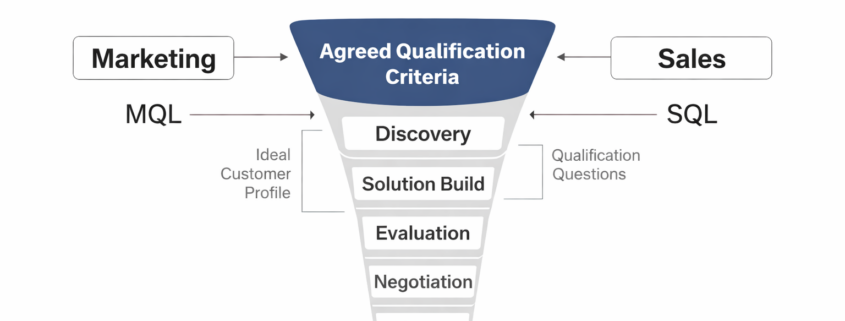
How valuable are marketing qualified leads (MQLs) to your organization? MQLs are incoming leads generated by your marketing department, usually by encouraging prospects to come and engage with your business via the website, blog, newsletter, webinars, live events, etc.

The quality of these leads depends on many factors – here are a few:

  • How qualified is the audience? Exactly where did the marketing group find these prospects, and how closely do they match your ideal customer profile? The most successful lead generation campaigns are able to work from a well-defined customer profile and engage technology to specifically target that audience. The Sales management team needs to collaborate with Marketing to hone this profile for consistency.
  • How well have the leads been nurtured? Is your marketing department handing over leads the moment a prospect interacts with your site, or are they categorizing different types of interactions and customizing a response based on where those prospects are in their buying cycle? Prospects who are new to the site may still be trying to understand what their problem is and beginning to investigate solutions. Those that have had a higher level of engagement with your content or are repeat visitors are likely farther along in the buying cycle and ready for some targeted messaging or special offer to encourage them to look at you over your competition.
  • The human factor – at some point, someone in your organization will need to have a phone interaction with these leads and use qualifying questions to determine how good the prospect is, and whether or not they’re ready to hand them over to an account team. Whether this “pre-sales” function lies in marketing or in sales is up for debate, but this initial conversation is crucial in order to disqualify leads that are not good candidates for your product and will just end up wasting your time.

Many organizations want to know how well their marketing department is doing in generating MQLs, and whether or not they’re really “sales-ready”. How many of those leads is sales able to convert to paying customers, and what is the effort involved in doing that? Unfortunately, benchmarking your performance against other organizations is very difficult. Numbers will vary from industry to industry, and your definitions of what constitutes a MQL are likely to be very different from those of other organizations.

Improving the Matching Process

So how can you improve the consistency on the criteria that Marketing and Sales use to turn leads into revenue? The key is to understand how your market works, what are your levers for growth, and how are you doing compared to historical data. To do so, ask Managers from Sales and Marketing the following:

  • What is the ideal customer profile and where do we find that person?
  • Do you have a process in place to get that person to engage with your website and continue that engagement throughout the entire buying cycle?
  • Have your sales and marketing organizations come to a mutual decision about how these prospects will be nurtured along the way – when should key interactions like qualifying calls take place and who should be handling these activities? Have you established SLAs for sales follow up on SQLs?

Mastering the art of converting a MQL to a SQL (sales qualified lead) is not easy, but organizations that are able to execute on this will achieve higher sales numbers and more sustainable long-term growth.


 

It may sound counter intuitive, but patient salespeople are always the most successful.  The stereotype of the sales person who won’t take no for an answer, who repeatedly closes and who is relentless about cold calling may make entertaining television, but the evidence points to the patient sales person as the role model for an effective sales organization.

Look at your quarterly or year end results.  Did your sales team discount heavily in order to make the quota?  Has your pipeline of opportunities been cleared out to hit the numbers “at any cost” with that cost being a huge hit to your margins?  I’ve seen this in organization after organization where the sales team and management have not focused on effectively managing their sales process and opportunities throughout the quarter only to resort to panicked, premature closes to many opportunities.  More often than not, this “haste” lays “waste” to your margins and bottom line.

Taking the time early in the quarter to assess your pipeline and schedule business development activities on an ongoing basis is the first step to building patience into the sales process.

Being prepared to listen to the customer to determine their goals is another skill that requires a sense of restraint among the average seller who is too often quick to spray the buyer with product offerings and features hoping for a quick close.  If the seller doesn’t take enough time to fully understand how the customer will use their products, the buyer may get confused about irrelevant features or feel they are buying features they don’t need.

Buyers don’t often like to be told what to buy – particularly by sales people who they feel have a bias to push the sale regardless of the fit.  By listening to the customers needs, sellers are better able to establish the value of their solution.  By being patient, the seller is able to propose usage scenarios to the buyer which positions the seller as a credible consultant and the buyer is more likely to share the values of the alternative usage scenarios.  By exploring the value of the seller’s product usage more fully, the buyer can calculate the benefit of buying the product and the savings of buying it sooner versus later.  Often times the cost of operating without the seller’s solution can be significantly greater than the benefit of negotiating longer for price concessions.  Once the buyer determines that is the case, the urgency to close the deal increases.

Key Points:

  • Listen to the customer’s needs
  • Let the customer establish a goal
  • Establish value for your offering
  • Don’t close prematurely
  • Patience provides strength in negotiation

Developing a sales organization that respects a process that takes the time to better understand the customers need will result in a more predictable revenue stream, a higher win ratio and better margins – all rewards worth being patient for.

Flannery Sales Systems (www.Drive-Revenue.com) helps organizations develop and implement a repeatable sales process.  Improving the effectiveness of your sales organization is the key outcome we provide to clients.  We would welcome an opportunity to explore your needs and understand where you could benefit from improved skills and sales processes.  Flannery Sales Systems works with a broad cross section of industries and we are confident we can enhance your results.


We’re kicking off a new customer Workshop just outside Memphis from February 22–27.

This is my first time in a city that has shaped modern music. It’s where The Blues became the backbone of Rock and Roll. The fundamentals were built here.

Home of Elvis Presley. I’ll stop by Graceland to pay respects.

The Memphis Blues crossed the Atlantic and helped shape The Rolling Stones (my favorite). Roots → refinement → global impact.

We take the fundamentals of Sales Process and Coaching, the structure, skills and execution turn it into something scalable, repeatable, and powerful.

Memphis proves it: The basics matter. Execution makes it legendary.

If you’re nearby that week, let’s connect. Time to make a little rock and roll of our own.

Last week I attended (virtually, on campus) in the Memorial at Brown University following the tragic events of December 13. Dozens of lives have been permanently altered, and the issue at the core of this pandemic goes unchanged. What are YOU going to do about it?

It’s the first thought that most sellers have when they initially engage with a prospect. Conscious and subconscious ideas drift in to try and size up this person, analyze the words they use (is this a Decision Maker?) and determine if this “hot lead” will ever make it into my Revenue Pipeline for a review with my boss (ugh).

This is a tough question to ask someone you just met, although I will include it in a book I have in DRAFT mode called “Shit I’d Love to Say to Customers”. And, if the fantasy of this scenario plays out, and the prospect says “Yes, I am going to buy from you (trumpets sound)”, you then get to ask the most logical, follow-on, seller-centric question ever… WHEN?

Don’t forget to explain to this newly minted, damn-near-customer that you must give your Manager an update on how the call went (GREAT is always the answer) and what the next step is (closing, of course).

A one-step sales process. Meet, Ask the Top Two Questions and Close. Damn, that was easy.

If this works, please call me immediately. We have a book to write, a speaking tour to schedule and umpteen dozens of Workshops to deliver. The good news- the training sessions will be short.

When I’m retained by clients to help their sales team, the first thing I do is to ask to interview their top performers. My purpose is to decode their selling DNA and identify the markers that make them successful.  

Invariably, effective salespeople sell value, not solutions or services. They recognize that it’s the ‘why’ that resonates with buyers – the business value. Equally revealing is illustrating how today’s problems impact the overall bottom line. But selling value and the total cost of problems facing a customer is where many sales teams run into trouble.  

Pinpointing and helping customers articulate these positions may not come naturally but it’s a necessary practice if you want to meet or beat your goals. Top performers use the following three tactics to draw out the answers to business value and the cost of challenges.  

  1. Get to the cost of today’s problem. Buyers face a number of problems and challenges.  Great salespeople help buyers define – in totality – all of the costs these problems bring. While costs may be non-monetary, such as frustration or low morale, the numbers that hit the bottom line are those that are heard by every person involved in the buying decision. Great sellers shape and frame conversations around the costs of the buyer’s problems. This is especially important if the solution’s value comes with a higher price tag. Early conversations around costs will help sell more and ensure that the necessary margins are hit in the end. 
  2. Tell stories. Stories help buyers discover for themselves the problems that they are facing and the solutions they need. High achievers have several stories at the ready that they can tailor and share based on the buyer’s situation or desired outcome. When the conversation lulls and the buyer is unable to explain their problem, share a story! Start by framing who the experience is about. Then identify the problem, turning point and resolution. Buyers who hear successes and failures of industry peers become more willing to share details about themselves and have an easier time finding their voice. Stories not only get to problems, they also help describe how others use and derive business value from your products. Stories have purpose and great salespeople use them again and again. 
  3. Summarize conversations in writing. This is a tactic that all sellers tell me they do, but few do it well. I sell my services to many companies in different industries. I constantly refer to follow-up emails I’ve written after conversations. The emails sum up problems a client is facing and the associated costs, the solutions we discussed and their value, and of course, proposed next steps. These emails help the customer and I keep the focus on the problems we are trying to solve. Top performers don’t rely on memory. They simplify, write the plan down, share it with the customer and allow the customer to give feedback. 

If you want to sell the business value your products bring, incorporate these techniques and the process will be habit in no time.   

It was bound to happen, a matter of time. It’s simple math. I told myself all the above, and more.



Over the past two weeks, I have worked and met with my Adult kids’ friends in two different cities. With 39 years in Sales, the next generational rotation was bound to come my way. And what a pleasure it was in both scenarios.

First was in San Francisco at the JP Morgan Healthcare conference. En route, I spoke with a friend of 35 years who I attended San Diego State University with. She let me know that her son was working at Salesforce.com in downtown San Francisco, and the next thing I knew, I was on a tour of their gorgeous 61-story building. The top floor is where the attached picture with Ben Cox was taken; he is in Sales in the SMB division at SFDC. What an enthusiastic, knowledgeable, fun young man Ben is-he will go far.

And last week in Houston, while attending a new customer’s Sales Kickoff meeting, Kayla Greibl stepped into the shortened Workshop Manager role as we provided the Executives and Sales Leaders with a half-day overview of their Sales Process. Kayla played volleyball at Brown University with my daughter Hannah, the latter graduates in May. Having seen Kayla play at a high level, and complete a rigorous academic curriculum made it even more enjoyable to work with her in a high-energy session.

Both experiences left me reflecting on something I see more clearly than ever: this generation has extraordinary access to information, but what differentiates them is how they create value in conversations. They don’t default to telling. They listen. They observe. And when they speak, it’s usually grounded in relevance.

Sales processes, tools, and methodologies matter. But they only work when paired with curiosity and respect for the buyer’s perspective. Watching the next generation operate in real business settings reinforced a belief I’ve held for a long time: access opens doors, but value earns trust.

And trust, as it turns out, isn’t generational at all.

As we look ahead to 2026, one theme continues to surface in nearly every conversation we have with sales leaders, managers, and sellers:

Access and Value.

Not as slogans. Not as abstract ideas. But as practical, repeatable capabilities sales teams must execute consistently if they expect to win in more complex buying environments.

Every sales process we co-develop with customers is built around core concepts. For 2026, Access and Value sit at the center. Not because they are new, but because most organizations still struggle to operationalize them.

Access: The Foundation for Everything Else

Without access, nothing else matters. And access today is harder to earn, easier to lose, and more tightly controlled than ever.

In the sales processes we build with customers, Access is applied in three specific ways:

  • Access to the top of the funnel while prospecting. High-performing sellers don’t just research; they use insight to earn relevance and credibility in the first conversation.
  • Access to Key Players. Deals rarely stall because solutions fail. They stall because sellers don’t reach the people who own outcomes, budgets, and risk. Access must be intentional and earned.
  • Maintaining Access throughout the buying process. Access is not permanent. It must be reinforced by adding value, advancing clarity, and helping buyers make better decisions.

Value: Created, Not Claimed

Value is not what you say your solution does. Value is what the buyer recognizes, internalizes, and can defend.

Value shows up in three ways:


  • In every conversation, each interaction should leave the buyer clearer or better informed.
  • Value from the prospect’s perspective is connecting your capabilities to operational, financial, and motivational impact.
  • When Value is clear, negotiation becomes about tradeoffs, not discounts.

Tactical Execution

To support this 2026 focus, we will provide access to our customers the blog posts aligned to each of these six topics. This allows teams to turn Access and Value from concepts into execution.

John traveled to La Paz, Baja California, Mexico where he discussed customer’s kick off meetings for 2026.


Each year at the JPMorgan Healthcare Conference, I build additional perspective on the Life Sciences and Biotech industries that we have participated in for 21 years. The range of people I meet, the types of companies they serve or represent, and the breadth of nationalities present make this the most diverse gathering we attend.

In just three days, I cross paths with people from 7 different countries, and leaders and representatives from more than 40 companies engage in dialogue, both formal and informal. These conversations share perspectives that spark curiosity and keep the fire lit.

On my way out of the final reception, I find myself in conversation with a woman from Moscow—a PhD/MD and Managing Director of a global investment fund. She asks me, “What is the key for you to get the most from these events?”

I answer without hesitation: listen.