
John travels to Savannah, Georgia and enjoys the colonial vibe amongst the Southern charm. The people here are warm and friendly-how about the Key Players in the opportunities you are developing? Do you get access to them all before the proposal is sent? Click the video link to hear more.
Archive for year: 2026

Most high performers don’t have a skill problem. They have a belief problem.
They’re capable, experienced and respected, yet somewhere along the way a quiet story took hold: “I can’t delegate that.” “Our team can’t hit that number.” “Now isn’t the time.” Those beliefs shape behavior, and behavior shapes results.
That’s the focus of the Performance Mindset Shift™ Experience, a new 12-week virtual program led by keynote speaker and former CareerBuilder sales executive Jamie Crosbie, CSP. Starting in mid-January, Jamie will personally guide a small group of no more than 10 people through her Belief → Behavior → Breakthrough™ framework, helping them spot the beliefs holding them back and turn new thinking into lasting change, both professionally and personally.
The Experience includes:
- Interactive small-group sessions
- Practical tools to apply between sessions
- Direct access to Jamie throughout the 12 weeks
It’s built for leaders and professionals who are really good at what they do but feel stuck or stretched thin, and who want the new year to bring more than a fresh set of goals.
The first group is intentionally small. Learn more and reserve a spot: jamiecrosbie.com/performance-mindset-shift
Jamie Crosbie, CSP, is a global keynote speaker, TEDx speaker (more than one million views) and three-time author. She is Founder and Chairwoman of ProActivate and former Vice President of Sales and Training & Development at CareerBuilder, and the creator of the Performance Mindset Shift™.

Each of the engagements we have with our customers begins with a thorough understanding of their business objectives. We then back up and attempt to help our customers to identify how their customers get to them or if they initiate the contact. We ask questions such as: What steps did prospects who looked at your organization go through to move from interest to onboarding?
The concept of the Buyer’s Journey
There is a lot of noise in the sales enablement space today about mapping “the customer’s journey” and then aligning it to the sales process. This is hardly a new approach. It is a dust–off of a three–decade–old concept, decked out with fresh wrapping paper, buzzwords and a shiny bow to get companies to think more about customers than themselves and the products they sell. A dust-off yes, but still a useful approach if it helps sales teams to understand the phases of the buyer’s journey.
To help our customers understand what matters to their customers, we rely on research by Neil Rackham. Rackham is the author of SPIN Selling. Rackham’s research yielded a chart that documents the three phases a buyer goes through, as well as what is important to the buyer in each of the phases. Much has been written about this research, and the use of the model has gone through adaptations when major innovative and market forces, such as the Internet, have entered the environment. But in general, the phases hold true.
- Phase 1is called Solution Development. At this time, the main concern of the buyer is their needs, although we often replace the word “needs” with “business objectives.”
- Phase 2is called the Evaluation. During this phase, the most important component to the buyer is proof: proof that your organization’s services and capabilities can match the buyer’s business objectives.
- Phase 3is called Commitment. The most important component to the buyer when they are ready to commit, or make a decision, is risk. The risk comes from the uncertainty of knowing if their selection will do what was promised. This is especially true when moving from one competitor and another in the same industry.
Note that price and cost are of course concerns for the buyer, but never are they the most important concern at any point in the sales cycle. Despite what you have heard about phrases like “sharpen your pencil,” or “give me your best and final,” price is rarely the final factor, and you’ll see it’s conspicuously absent from the three phases described above.
Do you know which phase your buyer is in?
It’s important to understand what phase your customer is in when you engage with them and make sure you identify what’s important to them. You also must recognize when different buyers are in different phases. For example, you could have three different buyers in an organization at different places along the buying phases spectrum.
It is the sales person job to make sure that they cover all three of the buyers’ phases, regardless of where the buyer is on the initial contact. This is one of the reasons that proactive new business development is critical for salespeople. If they can initiate the identification of a business objective, they will be in the driver’s seat to shape how that gets addressed, preferably in a specified solution that your competition can’t offer.
An engaged sales process means knowing your buyer’s business objectives, offering them proof, and getting them to commit.
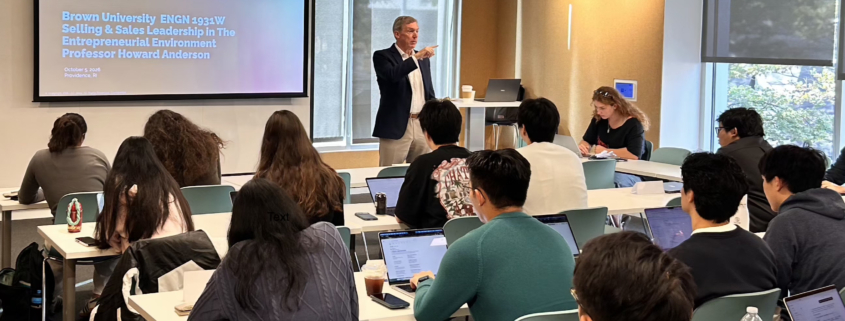
Following my guest lecture at Brown University last week, I had the opportunity to speak with six students from the class and the Nelson Center for Entrepreneurship program.
One particularly insightful observation came from Kira Ivanova, who followed up by email requesting a conversation.
She wrote:
“I am currently a junior doing a double concentration in Engineering and Economics, and although my academic background is quite technical, I’ve become increasingly interested in sales and business development as a complementary skill. I’m particularly interested in how technical knowledge can be translated into a compelling value proposition and ultimately into a business relationship.”
Get this right, and your ability to generate meaningful revenue for customers takes off.
At 20, this young woman recognizes something many organizations, particularly in Life Sciences and High Tech, continue to miss: the connection between technical expertise, customer value, and business relationships.
As we approach the end of 2026, it’s time to look forward to the year ahead—starting with an assessment of your sales team’s performance over the past year. How did they do? Where do the need to improve?
More importantly, how do you measure their performance so you can answer those questions?
To remove the subjectivity and help you take a quantitative approach in evaluating your team, we’ve developed a list of questions that get at the answers. Use the questions to distinguish the producers from the laggards. And use these questions to determine which skills your salespeople need to improve on in order to meet and exceed goals.
Also see if you can match the question posed with the corresponding sales skill. (You’ll find the answers at the end of this article.)
Questions for quantitatively measuring sales performance:
- How many of the qualified opportunities in your current sales pipeline were initiated by the seller?
- What title(s) most commonly appears in the field for primary point of contact? Is that a decision maker’s title?
- How well matched are your company’s product or service capabilities with the prospect’s business objectives?
- What value (outside of product/price) will the prospect’s organization be able to identify while working with your company?
- How much research does a prospect do before engaging with a salesperson?
- Who on your sales team held the margin line in the negotiations, and who caved to the buyer’s pressure?
In addition to answering these questions, also evaluate your team individually. How well can the individuals on your teams execute each skill? By using the questions above, managers can identify who has which skills and where improvement is needed. This is how your qualitative analysis of skills can be analyzed in relation to the quantitative assessment.
Here’s an example of the kind of insight you can gain: We worked with a company that calculated the cost of every sales call to be $400.00. They discovered that many of the calls were to prospects who would never produce enough revenue to cover the cost of the calls made. The managers were then tasked to analyze how well the reps could execute each step, and then identify where coaching was needed. As a result, the reps’ overall skills improved, the amount of time spent on the wrong prospects was reduced, and revenue results increased with fewer overall calls being made. In essence, the focus is on the quality of the calls versus the quantity of calls conducted. All because they took a quantitative approach using these questions.
Here are the skills that match each question above: 1) New Business Development 2) Accessing Key Players 3) Qualification and Positioning 4) Establishing Value 5) Opportunity Management/Forecasting 6) Negotiation.
Listen first. Sell second.
Effective selling isn’t just about presenting what you offer. It’s about understanding the customer’s business objectives, where they are in the buying process, and what they need to move forward.
That’s part of the approach behind the Translation & Localization Sales Process Workshop, brought to you by Nimdzi Insights and Flannery Sales Systems.
The workshop gives teams the opportunity to develop and practice the skills needed to establish value, manage opportunities, access key players, and ultimately help customers move through the buying process.
📍 Prague
📅 September 22–23, 2026
To register or learn more, contact John E Flannery 🌍 at john@drive-revenue.com.

Watch video HERE.
Many sales executives are laser focused on filling their pipelines for the rest of the year. Successful sales leaders know that a pipeline filled with qualified opportunities is essential to building sustained and repeatable revenue results, which is ultimately the fuel that drives organizational success.
The path to get to a healthy pipeline is not necessarily well understood and includes a number of variables, including the talent of the sales reps, market shifts, government regulations, and the competitive landscape. Despite these factors, there is one element that remains constant – selling skills. To have sales reps who successfully fill the pipeline with qualified opportunities, they must know how to identify, qualify, develop and close opportunities.
Most sales managers are well-versed in deal coaching. This means they know how to help their reps assemble the right mix of product and pricing to meet a customer’s requirements. While this is important, it does not address the fundamental need to understand how well the rep has qualified the opportunity, identified key players, and aligned your product/service offerings to meet the prospect’s business objectives.
Each of these three steps requires specific skills, and managers who help their reps improve these skills are ones that will see the biggest impact to their overall sales pipelines and year-end results.
Want to understand what prevents your sales managers from prioritizing skills coaching? Check this article out. And look here for tips on successful skills coaching strategies.