“Clear the noise,” says my wise friend from Krakow, Poland, Andrzej Nedoma, who has seen a thing or two in the business world.

Andrzej and I met twenty years ago through Renato Beninatto, when he was building the first of two successful companies in the Language Services Provider (LSP) industry. He attended the LSP Sales Process Workshop we ran in Barcelona and adopted that revenue model as the backbone for his global sales team.

Fast forward to a few weeks ago here in San Diego, and Andrzej is now coaching CEOs and founders on how to build, expand, and ultimately sell their companies. What stands out every time we talk is his ability to simplify priorities.

In sales organizations, the same principle applies: clear the noise and focus on what matters.

Great to see you again here in San Diego, amigo. Our last gathering in Krakow was far too long ago.

Focus.


Do Simple BetterThe quote on a t shirt worn by Joe Maddon, the former Manager of the Chicago Cubs (an American baseball team) inspired me. It said “Do Simple Better”. Professional athletes focusing on how to do the simple things, better.

Hmmm, Do Simple Better. What does that mean to your team? In Sales, this is what the focus should be on, and as fundamental as it sounds, doesn’t always happen in the heat of identifying, developing and closing a healthy Sales Pipeline filled with qualified Opportunities.

  1. Understand the Prospect/Customer’s Primary Business Objectives (PBOs): what is the Decision Maker hoping to accomplish if they purchase your product or service?
  1. Identify the Challenges: what is happening in their business today that inhibits them from reaching the PBO? And what is the impact, financial and otherwise, if they don’t make a change?
  1. Align Your Capabilities: how do your capabilities help the Decision Maker to address the Challenges? Be specific in matching the capability, and make sure the prospect identifies the VALUE they could obtain through the use of your capabilities. If they can’t, you should be able to help paint the picture on value.
  1. Agree on a Clear Next Step: what is the next step that the prospect and you are taking to move forward?  My colleague John Golden calls this an advance, as opposed to a continuation. Are we advancing this opportunity to the next step, or in a stall with one of the above mentioned items incomplete?

Items # 1 through 4 are the SIMPLE, or The Basics for sellers in early Opportunity development. They should all be discussed, documented and agreed to with the Decision Maker BEFORE sellers create a quote, write a proposal, ask for technical support or Marketing resources, build a presentation or respond to a tender/RFP.


Sales Leaders, it’s time to Coach your sellers to get the Simple right. Right now.


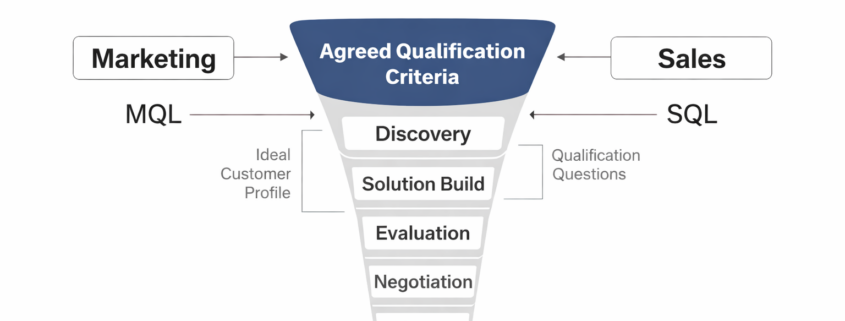
How valuable are marketing qualified leads (MQLs) to your organization? MQLs are incoming leads generated by your marketing department, usually by encouraging prospects to come and engage with your business via the website, blog, newsletter, webinars, live events, etc.

The quality of these leads depends on many factors – here are a few:

  • How qualified is the audience? Exactly where did the marketing group find these prospects, and how closely do they match your ideal customer profile? The most successful lead generation campaigns are able to work from a well-defined customer profile and engage technology to specifically target that audience. The Sales management team needs to collaborate with Marketing to hone this profile for consistency.
  • How well have the leads been nurtured? Is your marketing department handing over leads the moment a prospect interacts with your site, or are they categorizing different types of interactions and customizing a response based on where those prospects are in their buying cycle? Prospects who are new to the site may still be trying to understand what their problem is and beginning to investigate solutions. Those that have had a higher level of engagement with your content or are repeat visitors are likely farther along in the buying cycle and ready for some targeted messaging or special offer to encourage them to look at you over your competition.
  • The human factor – at some point, someone in your organization will need to have a phone interaction with these leads and use qualifying questions to determine how good the prospect is, and whether or not they’re ready to hand them over to an account team. Whether this “pre-sales” function lies in marketing or in sales is up for debate, but this initial conversation is crucial in order to disqualify leads that are not good candidates for your product and will just end up wasting your time.

Many organizations want to know how well their marketing department is doing in generating MQLs, and whether or not they’re really “sales-ready”. How many of those leads is sales able to convert to paying customers, and what is the effort involved in doing that? Unfortunately, benchmarking your performance against other organizations is very difficult. Numbers will vary from industry to industry, and your definitions of what constitutes a MQL are likely to be very different from those of other organizations.

Improving the Matching Process

So how can you improve the consistency on the criteria that Marketing and Sales use to turn leads into revenue? The key is to understand how your market works, what are your levers for growth, and how are you doing compared to historical data. To do so, ask Managers from Sales and Marketing the following:

  • What is the ideal customer profile and where do we find that person?
  • Do you have a process in place to get that person to engage with your website and continue that engagement throughout the entire buying cycle?
  • Have your sales and marketing organizations come to a mutual decision about how these prospects will be nurtured along the way – when should key interactions like qualifying calls take place and who should be handling these activities? Have you established SLAs for sales follow up on SQLs?

Mastering the art of converting a MQL to a SQL (sales qualified lead) is not easy, but organizations that are able to execute on this will achieve higher sales numbers and more sustainable long-term growth.


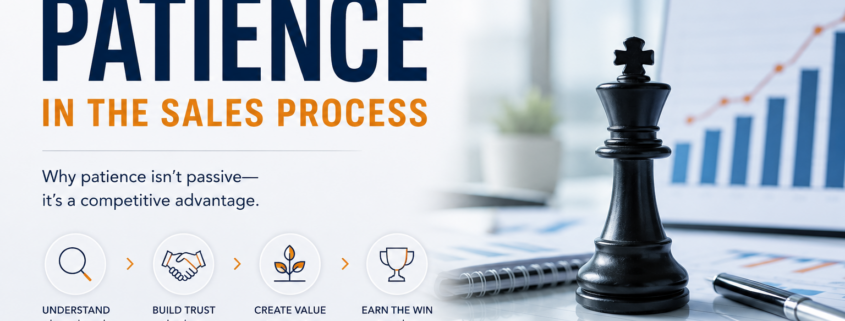
It may sound counter intuitive, but patient salespeople are always the most successful.  The stereotype of the sales person who won’t take no for an answer, who repeatedly closes and who is relentless about cold calling may make entertaining television, but the evidence points to the patient sales person as the role model for an effective sales organization.

Look at your quarterly or year end results.  Did your sales team discount heavily in order to make the quota?  Has your pipeline of opportunities been cleared out to hit the numbers “at any cost” with that cost being a huge hit to your margins?  I’ve seen this in organization after organization where the sales team and management have not focused on effectively managing their sales process and opportunities throughout the quarter only to resort to panicked, premature closes to many opportunities.  More often than not, this “haste” lays “waste” to your margins and bottom line.

Taking the time early in the quarter to assess your pipeline and schedule business development activities on an ongoing basis is the first step to building patience into the sales process.

Being prepared to listen to the customer to determine their goals is another skill that requires a sense of restraint among the average seller who is too often quick to spray the buyer with product offerings and features hoping for a quick close.  If the seller doesn’t take enough time to fully understand how the customer will use their products, the buyer may get confused about irrelevant features or feel they are buying features they don’t need.

Buyers don’t often like to be told what to buy – particularly by sales people who they feel have a bias to push the sale regardless of the fit.  By listening to the customers needs, sellers are better able to establish the value of their solution.  By being patient, the seller is able to propose usage scenarios to the buyer which positions the seller as a credible consultant and the buyer is more likely to share the values of the alternative usage scenarios.  By exploring the value of the seller’s product usage more fully, the buyer can calculate the benefit of buying the product and the savings of buying it sooner versus later.  Often times the cost of operating without the seller’s solution can be significantly greater than the benefit of negotiating longer for price concessions.  Once the buyer determines that is the case, the urgency to close the deal increases.

Key Points:

  • Listen to the customer’s needs
  • Let the customer establish a goal
  • Establish value for your offering
  • Don’t close prematurely
  • Patience provides strength in negotiation

Developing a sales organization that respects a process that takes the time to better understand the customers need will result in a more predictable revenue stream, a higher win ratio and better margins – all rewards worth being patient for.

Flannery Sales Systems (www.Drive-Revenue.com) helps organizations develop and implement a repeatable sales process.  Improving the effectiveness of your sales organization is the key outcome we provide to clients.  We would welcome an opportunity to explore your needs and understand where you could benefit from improved skills and sales processes.  Flannery Sales Systems works with a broad cross section of industries and we are confident we can enhance your results.