When a client engages us to help their sales staff, we often ask to interview their top performers. Our purpose is to decode their selling DNA and identify the markers that make them so successful. One common thing we’ve found is that top sales performers consistently help their customers to meet their objectives by selling business value.

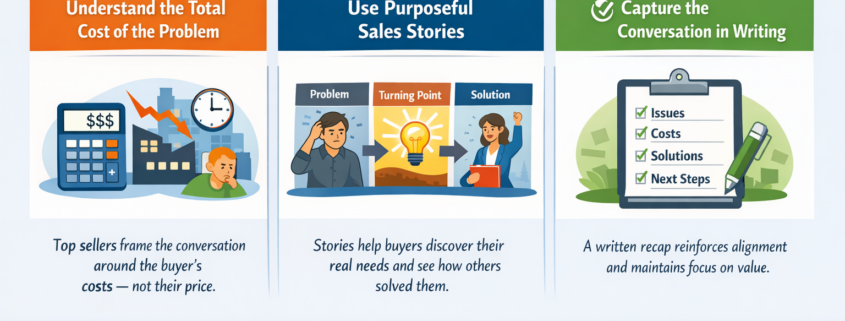
There are three tactics these top sellers employ to establish value:

  1. Get to the cost of the problem today.  Buyers will face any number of problems. Great sales people help buyers define in totality all the costs those problems bring. The cost may be non-monetary like low morale or frustration, but costs that strike the bottom line are numbers that are heard by every person involved in making the buying decision. When you are the high-priced product in the market, it seems that every buyer asks about prices first. Great sellers shape and frame conversations around the costs of the buyer’s problems, not on the price of their solution.  
  2. Tell stories. Stories help the buyers discover for themselves the problems they are facing or the solutions that are needed. Great sales people have several stories, personal experiences that they share depending on the situation or desired outcome. They share stories when the conversation lulls and the buyer is unable to articulate problems.  Stories have purpose and you begin them by framing who they are about, their problem, a turning point, and a resolution. Stories not only get to problems, they can be used to describe how others use and derive business value from your products. 
  3. Summarize the conversation in writing. All sellers tell me that they create meeting summaries, but few do it well. We sell our services to many companies in different industries.  I am constantly referring to the meeting summary emails I’ve written as follow up after our conversations. These emails summarize the problems they are facing, the costs these problems are causing, the solutions we discussed and value of those solutions, and, of course, the next steps as discussed. This helps the customer and I keep the focus on the problems we are trying to solve. Great sales people don’t rely on memory.  They summarize the meeting conversations by writing it down, sharing it with the customer, and allowing the customer to give feedback.

Have you used any of these techniques to establish value in your sales process? Do you have others you use? We’d love to hear from you. Send us an email to john@drive-revenue.com


Referrals are the best way to increase your sales.  When you begin to build your business through referrals, you lessen your dependence on having to make cold calls and other less productive (and frustrating) prospecting activities.  Yet getting qualified referrals is not automatic by any stretch of the imagination.  There is a prerequisite.

The most important concept to understand about referrals is that you must provide outstanding service, superior products and be professional in every way in order for anyone to consider providing you with referrals.  No one will want to refer friends and business associates to you if they are concerned that their referral might have a bad experience with you or your products.

The vast majority of professional salespeople who do provide outstanding service and quality products still do not get nearly the number or quality of referrals that they should, missing out on the easiest way to build their business.  As a result, they work too hard, have to resort to other, less productive, forms of prospecting and their business and income suffers. 

Why Don’t Salespeople Get Referrals?

If referrals are the easiest way to build business, why don’t salespeople get more referrals?  It’s not always due to the lack of quality or professional standards, but rather other factors, and this chapter will address them all.

  1. They don’t ask for them
  2. They don’t know how to ask for them
  3. They don’t tell the referring source what they’re looking for

Our experience is that most salespeople don’t know how to ask for referrals and as a result, when they do, they hear things from the potential referring source like, “I can’t think of anybody right now, but if I do, I’ll call you.” 

When someone asks you for a referral, what is your typical response?  If you normally say, “I can’t think of anybody right now, but if I do…,” then you are very susceptible to having what might be called “referral avoidance empathy” – a belief that your client feels the same way you do.  Then your subconscious thought process goes something like this:  I normally don’t give referrals myself and suspect that he doesn’t either, so why bother asking?  If that’s what you’re thinking, you’re done; it’s over.  No referrals for you.

There’s a lot we could say about referrals, but simply understanding the following will help you improve your referral business.

When to Ask

     The best time to ask for referrals certainly depends on a lot of factors. But here are a few ideas.

  • Set the stage early in the relationship.  (“At some point when you’re totally satisfied with us as a supplier, I’d like to ask you for referrals.  How do you feel about that?”)
  • After you’ve just completed delivery of your solution and your customer is satisfied.  (“Who do you know…?”)

Dos and Don’ts

  • Ask them about their willingness to give you referrals.  Don’t assume they will.
  • Begin the question with “Who do you know that…………….?”  Don’t ask, “Do you know anyone ….?”  It’s too easy for them to say, “I can’t think of anyone right now, but if I do……”
  • Ask to be introduced to their friends and associates.  Don’t ask to be recommended – it puts too much pressure on the prospect and is presumptive.
  • Focus your question on the end result to the client – a benefit or problem you can solve.
  • Phrase the question as though the referring source will be doing the friend a favor.
  • Tell your referring source exactly what you will be doing with the referral.  Don’t forget to keep the referring source informed of your progress.

Click here to read Part 2: including how to ask for a referral, what your ideal client profiles are, how to “upgrade” your referrals, and finally how to give more to get more.

John and the FSS team will be in Rome to work with a global commercial translation services company in the first week of February. Italy will be the 17th country that we have worked in, helping our customers to drive revenue in their approach to the global marketplace.

Rome has it all: history, art, architecture, food and finance, and a great place to gather perspective on the shifting landscape on business from the European continent to the rest of the world.

Would you like to meet with John in Rome? Join him for a cappuccino or plate of pasta to discuss your revenue generation plans, and how to get to the next level of productivity.

Until then, Ciao Bella!

As we approach the end of 2019, it’s time to look forward to the year ahead—starting with an assessment of your sales team’s performance over the past year. How did they do? Where do the need to improve?

More importantly, how do you measure their performance so you can answer those questions?

To remove the subjectivity and help you take a quantitative approach in evaluating your team, we’ve developed a list of questions that get at the answers. Use the questions to distinguish the producers from the laggards. And use these questions to determine which skills your salespeople need to improve on in order to meet and exceed goals.

Also see if you can match the question posed with the corresponding sales skill. (You’ll find the answers at the end of this article.)

Questions for quantitatively measuring sales performance:

  1. How many of the qualified opportunities in your current sales pipeline were initiated by the seller?
  2. What title(s) most commonly appears in the field for primary point of contact? Is that a decision maker’s title?
  3. How well matched are your company’s product or service capabilities with the prospect’s business objectives?
  4. What value (outside of product/price) will the prospect’s organization be able to identify while working with your company?
  5. How much research does a prospect do before engaging with a salesperson?
  6. Who on your sales team held the margin line in the negotiations, and who caved to the buyer’s pressure?

In addition to answering these questions, also evaluate your team individually. How well can the individuals on your teams execute each skill? By using the questions above, managers can identify who has which skills and where improvement is needed. This is how your qualitative analysis of skills can be analyzed in relation to the quantitative assessment.

Here’s an example of the kind of insight you can gain: We worked with a company that calculated the cost of every sales call to be $400.00. They discovered that many of the calls were to prospects who would never produce enough revenue to cover the cost of the calls made. The managers were then tasked to analyze how well the reps could execute each step, and then identify where coaching was needed. As a result, the reps’ overall skills improved, the amount of time spent on the wrong prospects was reduced, and revenue results increased with fewer overall calls being made. In essence, the focus is on the quality of the calls versus the quantity of calls conducted. All because they took a quantitative approach using these questions.

And as promised, here are the skills that match each question above: 1) New Business Development 2) Accessing Key Players 3) Qualification and Positioning 4) Establishing Value 5) Opportunity Management/Forecasting 6) Negotiation.

As we approach the end of 2019, it’s time to look forward to the year ahead—starting with an assessment of your sales team’s performance over the past year. How did they do? Where do the need to improve?

More importantly, how do you measure their performance so you can answer those questions?

To remove the subjectivity and help you take a quantitative approach in evaluating your team, we’ve developed a list of questions that get at the answers. Use the questions to distinguish the producers from the laggards. And use these questions to determine which skills your salespeople need to improve on in order to meet and exceed goals.

Also see if you can match the question posed with the corresponding sales skill. (You’ll find the answers at the end of this article.)

Questions for quantitatively measuring sales performance:

  1. How many of the qualified opportunities in your current sales pipeline were initiated by the seller?
  2. What title(s) most commonly appears in the field for primary point of contact? Is that a decision maker’s title?
  3. How well matched are your company’s product or service capabilities with the prospect’s business objectives?
  4. What value (outside of product/price) will the prospect’s organization be able to identify while working with your company?
  5. How much research does a prospect do before engaging with a salesperson?
  6. Who on your sales team held the margin line in the negotiations, and who caved to the buyer’s pressure?

In addition to answering these questions, also evaluate your team individually. How well can the individuals on your teams execute each skill? By using the questions above, managers can identify who has which skills and where improvement is needed. This is how your qualitative analysis of skills can be analyzed in relation to the quantitative assessment.

Here’s an example of the kind of insight you can gain: We worked with a company that calculated the cost of every sales call to be $400.00. They discovered that many of the calls were to prospects who would never produce enough revenue to cover the cost of the calls made. The managers were then tasked to analyze how well the reps could execute each step, and then identify where coaching was needed. As a result, the reps’ overall skills improved, the amount of time spent on the wrong prospects was reduced, and revenue results increased with fewer overall calls being made. In essence, the focus is on the quality of the calls versus the quantity of calls conducted. All because they took a quantitative approach using these questions.

And as promised, here are the skills that match each question above: 1) New Business Development 2) Accessing Key Players 3) Qualification and Positioning 4) Establishing Value 5) Opportunity Management/Forecasting 6) Negotiation.

zp8497586rq

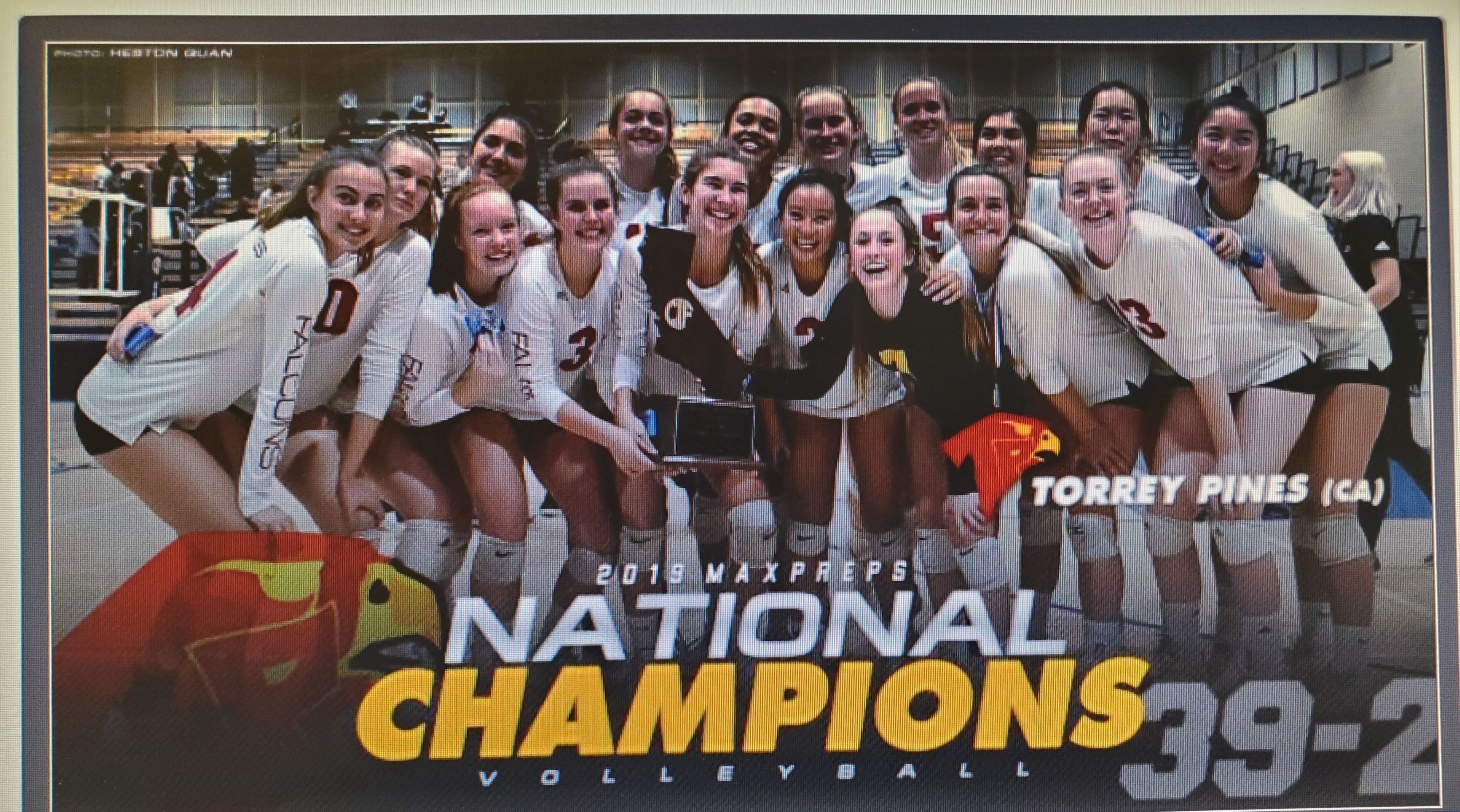
great teaamAbout 45 minutes after the Torrey Pines High School (TPHS, San Diego, CA) Girls Volleyball team beat Marin Catholic for the California State Title (CIF), the squad walked back into the lobby of the college gym where the match was held. The families of the players, including my wife and me, were waiting there to greet the girls following their straight sets victory on November 23. Shortly after their entrance, the tears of joy began to flow from players, Coaches and parents, as the energy in that foyer was so positive, loving, fulfilling and FUN! 

The hugs, high fives, pictures with the CIF State Champs trophy went on for a while. And then, the dancing began:    LINK  

As a Sophomore on the Varsity team, our daughter Hannah was treated well by everyone (see #3 below), got court time in some matches and played against the best in the country during their team practices. She, as did the other underclasswomen, learned a lot about the sport, but most importantly about what it means to be on a TEAM. A life lesson for being a part of a school, family, community, sports team and while giving back. 

TPHS Girls Volleyball TEAM is, as the father of an opponent said who we beat a week earlier, a “well-oiled machine”. And there is no coincidence/luck around how the girls did it. They did what great TEAMS do, to include the following: 

  1. Worked Hard: yes, they do have 7 girls who will play Division One College volleyball, but that didn’t stop them from laying it all out in practice and in matches. Yes, we all have to practice.
  2. Skills Focused: Hannah said her Coach told them whoever serves, passes and plays the best defense will win. They did, and they did. Never mentioned hitting or setting? 
  3. Leader Led without Egos: 5 Seniors in the starting 6, and 2 others on roster set the tone. It is about TEAM, not individuals. 3 Ivy League bound players were treated the same as the Sophomores…. no hierarchy. 
  4. Mindset & Belief: they knew they were excellent, took nothing for granted (as written on the back of their practice jerseys) and believed in themselves 
  5. Stick Together: high or low, on a hot streak or fighting to come back, they never wavered in their unity 
  6. Have Fun: they danced before and after matches, went to lunches together without Coaches, and spent time off the court hanging out. They like and trust each other, and it shows. 

As the cherry on top to a great season, a few days after the State Championship, three (out of four) of the top volleyball ranking organizations named them the Number One team in the country. Wow, it just was so wonderful, and has been a source of pride in their school and our community. 

In the end, it’s not necessarily about volleyball, or any sport. It is how we behave in the organizations that are part of our life. And this shining example is one that Hannah and her teammates will carry for the rest of their lives, on and off the court. Congratulations girls, we love you! 

This article is written by Dennis Hoeft, an experienced Sales & Marketing Executive with 30+ years experience leading, selling, managing and merchandising in highly competitive product and sales environments.  

Attending an industry conference is a costly endeavor: various factors such as transportation, lodging & meals can add up quickly. Add to that your time and effort, and well, that’s quite an investment! If you are planning to attend a conference this year such as PITTCON, it’s important to get the most out of these events in order to maximize the return on your investment. Here are 10 ½ tips to help you do just that:  
1) Plan well in advance; most conferences provide an exhibitor list as well as a list of attendees, so prepare a list of key people you want to meet. 

2) Several weeks prior to the conference, set up meetings with the key people you identified on your list; if you try to approach someone during the conference without an appointment, you might be out of luck if their calendar is already full. 

3) A few days before the conference, confirm the meetings that you have previously scheduled. 

4) Plan to spend some time ‘walking the floor’; attendees should spend this time looking for new and innovative exhibitors. Exhibitors should use this time to stay on top of their industry and find out what the competition is doing. 

5) Network; this is a great opportunity to make new contacts and expand your professional circle. 

6) Sit in on different seminars; try to learn something new about your industry or profession. 

7) Attend the various social events: dinners, cocktail hours, etc . . . meet new people, network, now is not the time to sit back & relax! 

8) Bring plenty of business cards to hand out; and, when you receive someone’s card, write pertinent notes about that individual on the back of their card immediately after you meet them. 

9) At the end of each day, do a quick re-cap to see if you accomplished what you set out to accomplish; adjust the next day’s schedule if you missed something important. 

10) When the conference is over, review your action items to make sure that you have captured & summarized all of them. 

And finally….  

10.5) When you get back to your office, FOLLOW UP, FOLLOW UP, FOLLOW UP! Address all of your actions items. Connect with new contacts on LinkedIn. Reach out by email and phone to build these relationships. Do what you said you were going to do.

You’ll be glad that you did!

Sales is a profession where so many variables come into play. The emotion of buyers and sellers, competing loyalties as to which is the “best” direction to go, and how to close the “big opportunity”. In his thematic song “Many Rivers to Cross”, Jimmy Cliff cites the trials and tribulations in life. How do we help sellers manage through this maze, and be consistent in orchestrating the outcomes?

We stick to The Core Concepts. Over the past 15 years, our customers and prospects have helped to validate the themes that they use to win. And we have consolidated this into the curriculum provided at our sales training sessions.

Have a look at the list we compiled here, and let us know your thoughts. Do you have any to add? Or would you edit what we embrace? Reply here to share.  

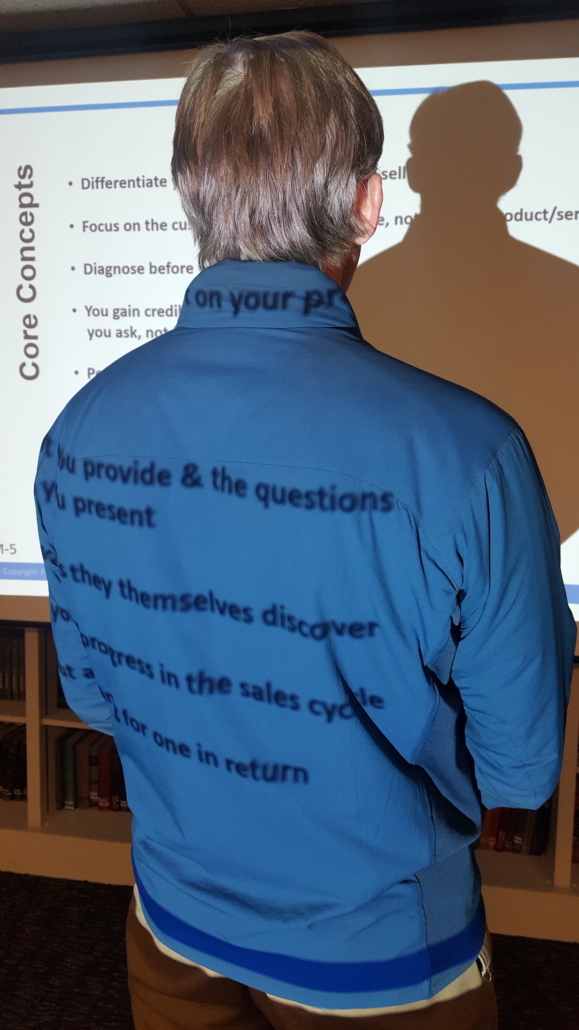
  1. Differentiate yourself by the way that you sell
  2. Focus on the customer’s business objective, not on your product/service
  3. Diagnose before you prescribe
  4. You gain credibility from the insights you provide & the questions you ask, not from the information you present
  5. People are best convinced by reasons they themselves discover
  6. Only the customer can validate your progress in the sales cycle
  7. Never make a concession without asking for one in return

If you ask just about anybody, “What makes a good salesperson?,” you’ll probably get similar answers across the board. People will usually tell you a good salesperson is energetic and driven with good communication skills. But they will rarely mention that how one sells matters too. And it does.

Here’s a story to illustrate our point…

A salesperson was in the lobby with other salespeople from competing companies, waiting for her first meeting with a buyer who represented a very large piece of revenue. This was the biggest “fish” our salesperson had ever tried to catch and her meeting was scheduled for only 30 minutes. Time was short. Nerves were high. You could feel the tension in the room among the salespeople.

Finally, it was our salesperson’s turn to meet with the buyer.

When she got into her 30-miute meeting, she began to ask questions. She didn’t start with a sales pitch. She didn’t start out by pointing out how her company differed from those represented by the other salespeople who were waiting. Instead, she started out by asking questions. She asked business questions and questions about how the buyer operated and ran his business. Her questions engaged the buyer, but they were also strategic: She knew the questions to ask to position her product properly.

However, the buyer was surprised by her approach. After answering the first few questions, he stopped her and said, “Why are you asking me these questions? No salesperson has ever asked me these questions.” Our salesperson was standing out. The way she was selling was differentiating her not just from the other salespeople in the lobby, but also from all the salespeople this buyer was used to.

When she explained why the answers to her questions were important for them to discuss, his whole demeanor towards her changed. He settled into his chair and started taking her questions seriously, giving them thoughtful answers. He spent an hour and 15 minutes with her, going well over the allotted 30 minutes.

When our salesperson walked out at the end of the meeting, some of her competitors who had been waiting were rescheduling their appointments because the buyer had spent so much time with her. And because she had the extra time with the buyer and therefore extra insight, she had a definite competitive edge over her competition.

When it comes to sales, it’s about how you sell too.

zp8497586rq

Workers in the developed nations of the world spend anywhere from 35 to 60 hours per week at their jobs. Of the time spent, there are many different components that comprise the total work week. For the companies that we work with, the 4 most important hours in each week are the sacred hours spent developing new customers (four is a minimum; startup companies and new reps will need more).

Many organizations do not have the correct structure, process or tools in place to facilitate new business development efforts. And while almost all companies will commit extensive resources to attract and keep new customers, some fail to get their customer facing representatives to commit to a set standard of time, with procedures and tools, for new business development every week. Call reluctance, or the fear of making contact with prospects is one of the many reasons that some shy away. In reality, that fear can be mitigated with the tools and skills to maximize the time spent.

We have helped hundreds of salespeople to develop and execute new business development campaigns. The key tool that we build with our clients is designed to conduct targeted conversations. This allows the seller to pinpoint goals and relevant business issues of a specific title in a prospect organization through diagnostic questions in a conversational format. The skills needed to execute the tool are also honed in our engagements, and first line managers are given coaching sessions to reinforce and correct selling behavior.

The American Marketing Association stated that “The conversations field salespeople have with prospects and customers may be the last bastion of competitive differentiation in today’s rapidly commoditizing markets.” To get your organization in the right environment to grow requires that customer facing representatives commit to new business development activities, and have a platform to work from that helps them to get into a relevant conversation as quickly as possible.

Today’s CEO has a lot to keep him or her up at night: regulations, compliance, automation, globalization, trade wars and talent management are only a handful of the pressing issues CEOs must contend with, although the highest priorities change with the times. One issue is always present on a CEO’s mind, however: sales.

What do CEOs really think about the sales arm of their organization? Even when the economy is strong and sales are up year over year, the CEO will have concerns. Here are the top four sales issues CEOs worry about, whether sales are up or sales are down, and how you can address them:

  1. The sales team is too slow. When the sales team is lagging 12 to 18 months behind the corporate strategy, opportunities are lost and goals are not met. If this is the case at your organization, take a look at how your sales team is or isn’t using technology to streamline and speed up the sales process. Technology enables agility. Put it to use.
  1. The sales team is calling too low. When the sales team fails to get to the right level in customer-prospect organizations, the sales process is slowed (see concern #1) or stalled altogether. If this is the case at your organization, make sure the team is doing the research necessary to reach out to the right person or position from the start. And remember, you’re referred to whom you sound like. So talk the talk and walk the walk of your ideal prospects.
  1. The sales team can’t diagnose business problems. The inability to diagnose business problems may be the reason salespeople are calling too low (see concern #2). The answer to this is coaching, coaching and more coaching. Harvard Business Review says effective coaching can improve sales productivity by 19%.
  1. The sales team can’t tell the story. Only a handful of CEOs think a typical salesperson can demonstrate an understanding of a prospect’s business issues and articulate how to solve the problem. This ties directly into concern #3. If this is an issue at your organization, start training your team to know the story and tell the story.

Did you notice that three out of four of these concerns have to do with knowing what to talk about, and not just whom to talk to? That means sales training is needed and processes put in place. Having a defined and customized sales process within your organization will help alleviate many of your CEO’s concerns about the sales team.