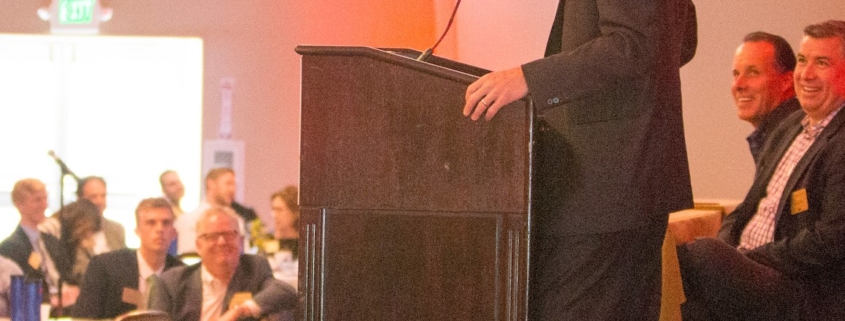
Last week I had the distinct pleasure to guest lecture at Brown University in Providence, RI. As some of you know, my daughter Hannah is in her third year there, studying Economics and playing on the volleyball team. It is always rewarding to speak at a university, but to do so in an Ivy League school where your daughter is enrolled makes it extra special.

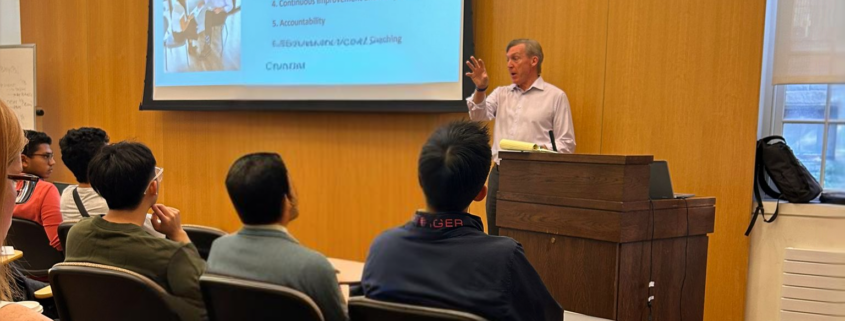
“Selling and Sales Leadership in the Entrepreneurial Environment” is the class I spoke with taught by Professor Howard Anderson. In his words, startups only have two problems: sales and all else.  The topic we discussed was how Sales Process plays a critical role in the tactical execution of a company’s commercial strategy. The students participated actively in this dialogue throughout the 90-minute session.

At least four countries were represented in the room (Kosovo, Russia, Egypt, USA) which reflects the diversity of the Brown student community which will soon impact the global business community. What a great day-a memory I will hold on to for a long time. Thank you, Professor Anderson, and Go BRUNO (the Brown bear)!

In the fast-paced world of sales, success hinges on more than just having a great product or service—it’s about reaching the right people. All too often, sales teams focus on delivering the perfect pitch but miss the mark by not engaging the true decision-makers. Identifying and speaking to the key players, those with the power to influence and make final decisions, can make all the difference between closing a deal or losing an opportunity. Knowing strategies to ensure you’re connecting with the right individuals in your sales process, helps  you to maximize your efforts and boost your success rate.

The energy on Wall Street is palpable. And as Sales organizations round out this year, and prep for 2025, that momentum has to carry through all team members. Listen in on how to harness that power for success.

In today’s competitive market, a well-defined commercial strategy is essential for achieving long-term success in sales. But what separates high-performing sales teams from those that struggle isn’t just the strategy itself—it’s how effectively that strategy is executed.

Tactical execution transforms a high-level commercial vision into real, measurable results.

Let’s explore the key elements of tactical execution in sales, and how businesses can align their teams to ensure every move propels them closer to their goals.

What Is TECS?

Tactical execution refers to the specific, actionable steps taken to bring a broader commercial strategy to life. While commercial strategy focuses on the long-term vision—such as market positioning, customer acquisition, and revenue goals—tactical execution is about the how. It’s the day-to-day Sales activities that ensure sales targets are met, pipelines are built, and relationships with customers are strengthened.

In essence, TECS translates your strategy into action. Without it, even the best commercial strategy will fall flat.

  1. Define Clear Objectives and Metrics

One of the first steps in tactical execution is ensuring every team member knows the specific objectives they are working toward. Sales leaders must communicate clear KPIs that align with strategic goals, such as:

  • The number of qualified leads generated.
  • Conversion rates at various stages of the sales funnel.
  • Average deal size or customer lifetime value.
  1. Use Customized Sales Tools for Conversations

Sales teams can no longer rely on instinct alone. The use of tools that are created for market specific applications for your product and services are essential. Forrester Research says only 26% of sellers know how to articulate the value their company provides. Don’t leave it to chance that the other 74% will get this right. Develop and adopt the use of tools in prep and Coaching calls.

  1. Align Cross-Functional Teams

Successful execution depends not just on sales but on a harmonious effort across marketing, customer success, and product teams. Cross-functional alignment ensures that everyone is rowing in the same direction.

Sales leaders must promote open communication between these departments to create a unified approach to achieving commercial goals. Regular interdepartmental meetings and collaboration tools, such as Slack or Microsoft Teams, can foster this alignment.

  1. Continuous Improvement and Adaptation

The business landscape is constantly evolving, and so too must sales tactics. TECS isn’t a one-time event; it’s an ongoing process of refinement. Adapting to changing market conditions or buyer preferences ensures that teams remain agile and ready to pivot when needed.

  1. Accountability

For tactical execution to succeed, every sales team member needs to be held accountable for their performance. Clear accountability fosters responsibility, but empowerment fuels innovation.

  1. Effective Sales Training and Coaching

Finally, none of the tactics will work without the proper skill set. Continuous sales training and coaching are critical for ensuring that your team has the expertise needed to execute the strategy.

Sales teams must be equipped with:

  • Conversation tools that allow them to present value effectively.
  • Negotiation skills to handle objections.
  • The ability to understand customer pain points and offer relevant solutions.

Conclusion

Tactical execution bridges a company’s commercial strategy and its success in the marketplace. By breaking down big-picture goals into clear, measurable actions and aligning sales efforts with other departments, businesses can effectively execute their strategy to drive revenue growth.

 

Every Revenue Stream is vulnerable to leaks, those gaps where potential revenue slips away unnoticed. Whether it’s poor follow-up, misaligned sales and marketing efforts, or inefficient lead qualification, these leaks can quietly erode growth.

Identifying and sealing these leaks requires:

Regular pipeline reviews

Improved communication across teams

Data-driven insights to track lost opportunities

By proactively addressing these gaps, companies can ensure more revenue flows where it should: to the bottom line.


Greetings everyone from Albania and Montenegro. I am enjoying adventure travel this week before a full week of Sales Process Workshops next week in Paris.
Click on the video above to hear the topics we will assist you with as we wrap up Q3! Hvala ( or thank you in Montenegrin).

Join a select group of 30 director-level peer experts for a breakout discussion on best practices for stopping revenue leaks and driving revenue growth.

You don’t want to miss this opportunity to transform your approach to revenue growth and secure long-term success for your organization.

Session highlights:

  • Equip yourself with tools and strategies to identify and eliminate revenue leaks, ensuring sustained revenue growth.
  • Learn from real-world case studies to develop a robust revenue leak prevention strategy.
  • Discover how to diagnose common revenue loss sources, quantify their financial impact, and implement effective solutions.
  • Engage in a breakout session with peers to share best practices and collaborate on strategies.
  • Walk away with a clear roadmap to optimize your revenue management processes and achieve your financial goals.

Masterclass experts:

John E. Flannery
President
Flannery Sales Systems
Gerhard Gschwandtner
Founder and CEO
Selling Power
Email me if you are interested in signing up:  john@drive-revenue.com

Note: Seating is limited and the organizers reserve the right to deny access to anyone that doesn’t fit the level of qualification required for this Masterclass.

I have had the unique opportunity to train with one of the best athletes in the world. Michellie Jones is one of the most accomplished triathletes in the history of the sport to include first place at the infamous Ironman (Ironwoman?) in Hawaii and numerous other victories. When she was asked how she prepares for an event, Michellie said “lots of rest after lots of training”.

The setting was a local “Boot Camp” that is put on by her boyfriend, and it attracts a variety of amateur participants. I was paired up with Michellie to go through an 8 station loop course to be completed three times within the 55 minute session.

In a triathlon, the components are: Swim, Bike and Run. In Sales, it’s: Identify, Qualify, Develop and Close.

Half way through the first loop, I began to notice my heart rate rise and sweat level increase. How many times has Michellie done this routine vs. the amateur she was paired with? She didn’t appear to be nearly as flustered going into the second loop as I was, and she was even keeled as I struggled onto the tires for a resistance exercise on a two person pulley.

There were eight stations in the Boot Camp loop, and there are six skills in sales that we identify where mastery must be fluent in order to succeed: new business development, needs analysis, accessing key players, identification of value, opportunity control and negotiating/closing. How often do you run through all exercises to make sure you are in a position to win?

To compare myself to a professional athlete is silly, so I won’t go down that path. But what is the differential between an average sales person and the top performers in the field? Preparation and training are the key components.

How much time are you spending refining your skills so that you put yourself into a position to win?

As I recall limping around the office in the past, I was amazed at how sore certain parts of my body were and was reminded what it takes to succeed. And while I won’t be planning to compete in the next Iron Man, I will be practicing my sales skills so I am ready to win the next opportunity. How about you?

In my business and personal travels, I have been fortunate to see many wonderful parts of the world. One of the main reasons this privilege exists, among other liberties we enjoy in free societies, comes from the sacrifice of others.

My recent visit to the Normandy Coast of France, specifically to Utah and Omaha Beaches, Sainte-Mere Eglise, Pointe du Hoc and the American Cemetery at Normandy impacted me significantly. My Father served as a Medic in World War II, and while he was not part of the D Day invasion, he gave up a significant part of his life (during and after the war) for our shared freedom. It’s hard to find the accurate words to describe the courage and selflessness these people found to deliver us from pure tyranny; the will of goodness versus an evil power that would have literally changed the course of our world.

We all should contribute to freedom. Upcoming elections in France and the USA, and other democracies are one call to action. Another means to honor those who sacrificed is to neutralize bullies who overstep their bounds, breaking written and moral codes while limiting the voice and choice of others’ way of life. Too much of this exists now.

Let Freedom Ring. “Merci Beaucoup” or a “Thank You” is not enough-we all must act.