As we celebrate the remarkable career of this iconic rockstar, let’s draw inspiration from his enduring success and apply it to the world of sales.

Like Mick, sales professionals must have the charisma and stage presence to captivate their audience. Whether it’s a live performance or a sales pitch, engaging your audience is key.

Just as Mick continuously evolves his music, successful salespeople adapt their approach to meet changing market demands. Embrace innovation and stay ahead of the competition!

Moreover, Mick’s perseverance through challenges is a valuable lesson for sales. In the face of rejection, keep pushing forward, refining your techniques, and learning from each experience.

Lastly, surround yourself with a talented team – just as the Rolling Stones have done. In sales, collaboration and mentorship can amplify your success.

Let’s toast to Mick Jagger’s 80 years of greatness and use his rockstar principles to excel in the art of sales coaching. 🥂 #SalesCoaching #MickJagger80th #Inspiration

If only your sales representatives could persuade their customers and prospects as effectively as they convince you, their manager, about the necessity of obtaining SPQs (Special Price Quotes) or discounts at the end of the month or quarter, you wouldn’t find yourself trapped in this predicament driven by buyers. Unfortunately, we often find ourselves in the final days of the month or quarter, where buyers sense the opportunity to negotiate lower prices and push sellers to meet their revenue targets. This scenario has become predictable and tiresome, but with the right approach, it can be handled easily. 

Some sellers are well-versed in countering this madness by establishing and emphasizing the value of their offerings early and consistently throughout the sales process. However, if you have neglected this crucial step and are now trying to close deals, it may be too late. If you have already done so, congratulations! You have equipped yourself with insurance for this high-pressure closing dialogue. 

According to Forrester Research, a mere 26% of CEOs believe that their salespeople possess the ability to help customers truly comprehend the value their organization provides. So, what about the remaining 74%? They are currently lining up at your office, seeking those SPQs. The decision to grant them lies in how effectively they sell the idea to you. 

To prevent this situation from recurring in future quarters, it’s worth examining the insights shared in the blog post “Help Your Sales People Hold Pricing.” Afterwards, don’t hesitate to reach out to us for a conversation. We are prepared and ready. Are your sellers? 


It all started last fall when the team from my original hometown, the Philadelphia Phillies, lost the World Series to the Houston Astros.

Then, in November, the Brown University Women’s Volleyball team lost the Ivy League Championship to Yale. My daughter plays for Brown. Ouch.

Follow that with the Super Bowl in February where my Philadelphia Eagles lost to the Kansas City Chiefs and just two short months later, my beloved San Diego State Aztecs went down to the University of Connecticut in the NCAA Men’s Championship. It was starting to feel personal…..

In sales, a loss is a loss — even if you’re the runner-up. After all, we only get paid when we win. And when we do not, we often hear buyers attempt to let us down softly with vague explanations such as “your product didn’t have this bell or whistle,” or, our favorite “you were just too expensive.”

But in sales, as in sports, what happens next is important. Do we take the time to learn why we lost? As we were developing that opportunity, where did things start to go awry?

We’re proud to say that the sellers we work with do. They have such a clearly articulated and aligned selling process that they can tell exactly where in the buying cycle something got missed. Maybe the buyers went quiet or skipped an agreed-upon next step?

One of the most important jobs Flannery Sales Systems does for our customers is to help them refine their sales process to ensure it is strategically aligned with the buying cycle. Doing this drastically increases their probability of success.

Want to minimize your chances of ending up in the dreaded runner-up position? Make sure the following checkpoints are an integral part of your sales process:

  • Do we have all key players identified?
  • Have we had targeted conversations with all key players BEFORE sending a quote or proposal?
  • Can all key players articulate our core value proposition?
  • Have we been able to build an implementation plan before the proposal is delivered?

Most of our customers’ selling situations are similar (despite the dire need some have of telling us “this one is UNIQUE”). Coaching them to use a sales process not only helps them understand how to win, but also has the added benefit of helping them identify where things go wrong. It is never pleasant to lose, but when it happens, we will take the time to learn from it as we set our sights on our next big win.


Most sales managers we speak with express frustration that their salespeople are not in front of enough qualified prospects.  Without an effective prospecting system in place, the sales pipeline is weak, creating pressure to be more aggressive in selling to less qualified prospects. This leads to poor sales and margins, frustrated salespeople, and concerned management.

Prospecting is an activity that is filled with rejection.  You’ve got to deal with gatekeepers, people claiming they’re happy with their existing supplier, they’re too busy to see you, etc.  In some industries, salespeople need to make 50-60 contacts just to get one appointment.

Most salespeople focus on the results of their prospecting efforts, and that’s a mistake.  While results are important, it’s impossible for you to control results. Our advice is simple – don’t worry about what you can’t control.   Instead, focus on those things that you can control.

You MUST Schedule Sacred Prospecting Time Each Week  

This is a must for all successful prospectors. If you don’t carve out and protect the prospecting time slot, other activities will creep into that time and dilute your efforts.  Another thing you can certainly control is your own behavior – the activities that you do.  If you set prospecting goals for yourself, such as making ten cold calls daily, every day you make those ten calls is a successful prospecting day. You won’t last long if you become discouraged every time a prospecting call comes up empty. Try changing your attitude.

Think of prospecting as a discarding activity.  You’re discarding those who are not prospects, and each time you discard one you get closer to that gold nugget.  Let’s face it, prospecting is a head game in many ways, so get your head straight if you want to win the game.

Don’t Put All Your Eggs in One Prospecting Basket  

Most successful prospectors have more than one method of prospecting.  They don’t put all their eggs in one basket.

Here are a few proven ways to find prospects, but every business is different and some of these activities may or may not fit you.  Select several that do fit your model:

  • Prospecting within your current accounts for expanded business where you have an established relationship.
  • Referral prospecting where you use your current customer base to refer you to others.
  • Networking at professional meetings, association meetings and anywhere else that your prospects or good referring sources may gather.
  • Participation at trade shows or special exhibits.
  • Newsletters, both in print and email.
  • “How to” articles in client-orientated publications.
  • Speeches at client industry meetings.
  • Cold calling

Once you’ve gained the attention of that hard-to-reach prospect, you’d better make sure that your initial message moves you forward, not backward.  This is where some salespeople blow it.  Given the chance to make a great first impression and set themselves apart from the competition, they do just the opposite. For tips on how to get that perfected, see our Prospecting post.

In my opinion, it’s this: “Does that make sense?”

I hear this question frequently in many capacities, and it makes me shudder. And here’s why it stinks. First, if the information that you are trying to convey to someone doesn’t make sense, and you then ask them, “does that make sense?”, how do you think that makes them feel? Are they really going to ask for clarification? What would that sound like? “No, can you start over?” or “I have no idea what you’re talking about.”

People are reluctant to make those kinds of concessions because it makes them feel inadequate, like there is something wrong with them that’s preventing them from catching on. I’ve seen senior leaders in organizations ask this question in small and large gatherings, and it just causes the gap between them and the audience to grow wider.

So, what would be a better choice? It depends what your goal is. If you’re trying to get confirmation that the customer is understanding what you’re saying, how about a question that extends the dialogue, like “how does this relate to issues in your organization? If so, tell me about them. Or, “ How do these topics impact your bottom line?” There are so many other creative ways to get a response, extend the discussion and learn more about their business.

The next time you’re meeting with a customer or presenting in front of a group, resist the urge to fall back on the question, “does that make sense?” Dig deeper, connect with your audience, and bring them into the dialogue with more pointed discovery questions that will help you better position your offering and the value that it brings.


John shares his insights with of Selling Power Magazine. He has been voted by Selling Power as one of the Leading Sales Trainers.


Many dedicated professionals (doctors, lawyers, CPA’s) have requirements on Continuing Education (CE) and knowledge standards to remain active in their specific trade. Oddly, Sales Professionals do not have a dedicated licensing body-imagine if we did? Buyers may appreciate it.

The place I go 2 to 3 times per year to get caught up on the most important topics in Sales is the Selling Power 3.0 Conference series hosted by Gerhard Gschwandtner. Year in and out, Gerhard assembles the most interesting, diverse, deeply talented speakers and topics to keep Sales Leaders informed as to what is happening in the Buyers and the Seller’s worlds. If you haven’t taken part, I strongly suggest that you do. In fact, if you read this far, and want to go to the next 3.0 Conference, I will pay for it-let me know. Good selling.

As humans, we tend to want to swoop in and fix things, often starting with the things that are most broken and most in need of repair. As sales managers, we pride ourselves on being fixers and judge ourselves on our ability to effectively coach our teams and give them the resources they need to be successful.  

But, just as not all salespeople are created equal (see Bottom Third Sales Coaching) nor are the opportunities they put in the pipeline. In both cases, though our tendency may be to start with the team members and opportunities that are most in need, this impulse is often detrimental to our overall success. Just as with the bottom third of our sales reps, the bottom third of our opportunities will rarely move the needle regardless of how much time or energy we put into them. Often these are opportunities that have not been well qualified and are not well suited to our product or service capabilities. Additionally, despite equal or greater time investment, they may not have the revenue potential that some of the other opportunities have. 

So, what’s the answer? As difficult as it can be, the answer is to put less time into your bottom third. Instead, focus your time on B and C opportunities. Why not your A opportunities? Because your top 10% of opportunities are so well qualified and such a good fit, that they’ll likely close with little to no involvement from you. So, spend your time on the B and C opportunities, helping your reps understand how your product or service will help their prospects increase revenue, decrease costs or mitigate risks. Spend time thoroughly qualifying these ones up front so they have a higher likelihood to close.  

Neglecting the bottom third of your opportunities is not shirking your sales managerial responsibilities; in fact, reallocating your time to focus on the 60% of your core B and C opportunities will be the best way to support your sales reps going forward by helping them move the needle. 

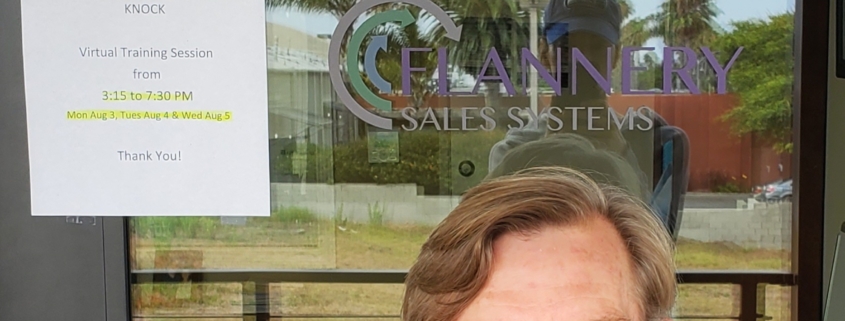
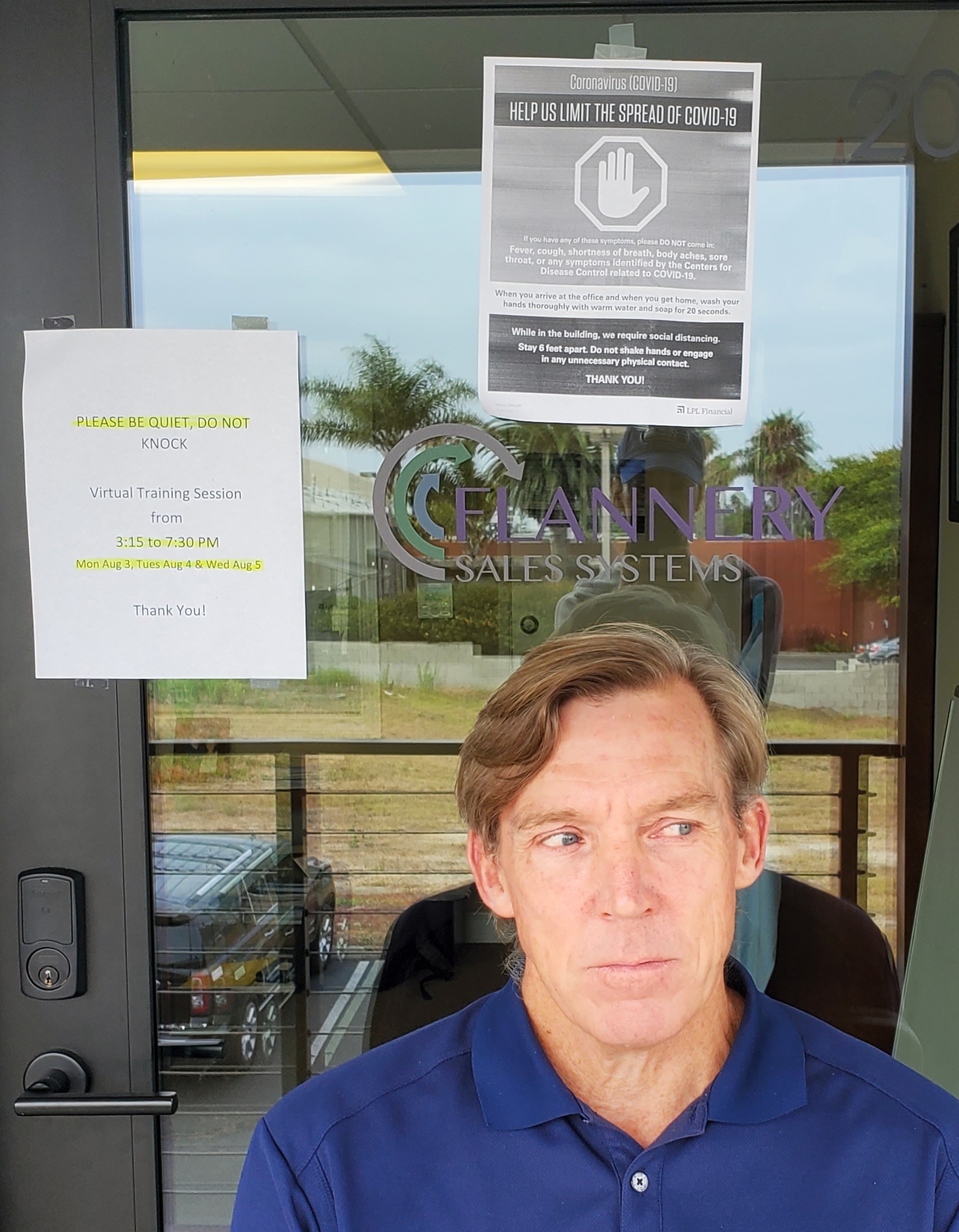
Last week, the new owner of our office building (so glad to NOT be working from home) put our logo on the glass door out front (see the photo attached). It looks great, although they changed the logo color for the name “Flannery” from blue to purple. I like it. A lot.

It reminds me that many things are simply not the same right now. It’s strange, and I am grateful for the opportunity for perspective in this environment.

We just conducted another virtual Sales Process Workshop through Zoom for a new customer in Australia , and it went very well by their account. Their participants were engaged, the exercises were given full attention, and they will get results from their efforts. It’s not the same as face-to-face, but it works. I’m grateful for the technology.

In the absence of being able to travel, we welcomed the new customer in cyberspace and built rapport as best we could. I miss travel badly, as it is part of the grand adventure of creating relationships in customer organizations and helping people improve. And for my personal growth, travel allowed me to be readily seeing new places, people and things. For now, it will have to be virtual, across the screen in various global time zones; I’m grateful for our customers’ willingness to embrace the experience.

Sitting atop the door in the picture is the prominent COVID 19 warning sign, the ones you are seeing all over the place to remind us to take all precautions we can to stay safe. And most of us do take those precautions—remarkably, some still do not. Selfish. We live and work in a beautiful part of the country where much of life happens outdoors, providing opportunities for gratitude all around us.

If I get stuck in the trap of comparing the ways things were “before” to the way they are now, my learning stops and my ability to grow is limited. By embracing the shift, and seeing what’s possible with the human spirit, gratitude floats.

*Article title inspired by John Lennon’s song “Nobody Told Me”. Have a listen here.

This guest article was written by Chris Bullick. Chris is a Principal Consultant who is the Creator of the Sales Diagnostic Questionnaire (“SDQ”), he provides analysis and strategy for go to market strategies, corporate messaging, pipeline metrics, relationship building and winning presentations.

I was speaking with a wildly successful colleague recently and she relayed the story of her latest accomplishment.  The company she was selling to was not necessarily in buying mode.  They reached out to a few vendors to conduct general capabilities presentations.  She had never met the buyer.

My friend’s presentation blew the doors off the buyer.  The buyer immediately put the wheels in motion to contract with my friend’s company to provide services to his and they never talked price until the actual closing. 

When I asked my friend what did the trick, she said her team prepared as if it was biggest and most important finalist presentation they had ever participated in.  

Best Practice: Treat every meeting like a finalist presentation.  Learn how to prepare for the big day.

She brought the team who would service the account, the potential account manager, a regional executive and a video from her company’s CEO imbedded into her PowerPoint that was customized for the prospect.  She noted that her biggest competitor was presenting right after her.  They sent one person and she learned later that their presentation was a generic one-page marketing piece. 

Best Practice:  Bring the team.  It’s great practice for those who are not in front of customers every day.  If you don’t win, you still may be setting the table for the future with that prospect.  Learn how to get your whole team comfortable presenting. 

Imagine that!  Allocating resources full bore on a deal with a low probability of success.  Do other organizations do that?  The answer is not many.   A lot of organizations handicap themselves out of deals.  They look in their CRM and see that they have tried to sell to that buyer in the past without success.  They think the buyer is just kicking tires or leveraging them on price.  Another great excuse is they haven’t met the buyer yet.  They place a low percentage of winning in the CRM. 

The organizations that handicap themselves will not allocate resources on a low percentage deal.   They will tell their sales people not to spend so much time on a deal like that, don’t burden marketing, don’t take anyone important and use generic marketing materials.  In doing so, they take the passion, urgency, energy and enthusiasm out of the deal.   They have set themselves up to fail. 

Best Practice: Don’t skimp on preparation and resources. Learn how to prepare the right way and bring the right resources to every meeting.  

Winning companies tell their sales people to jump in with both feet.  It’s alright to drop everything, muster your resources, and prepare with a mindset that you are winning the business right then and there.  When you present with conviction and purpose it reveals your company’s attention to detail, planning and execution.